


skip to content
National Farmers' Federation

Home About NFF Media Centre Policy & Issues Farm Facts Commodities Our Members Our Partners

Natural Resource Management

Farmers are at the frontline of delivering environmental outcomes on behalf of the Australian community, owning, managing and caring for 61 percent of Australia’s land mass.

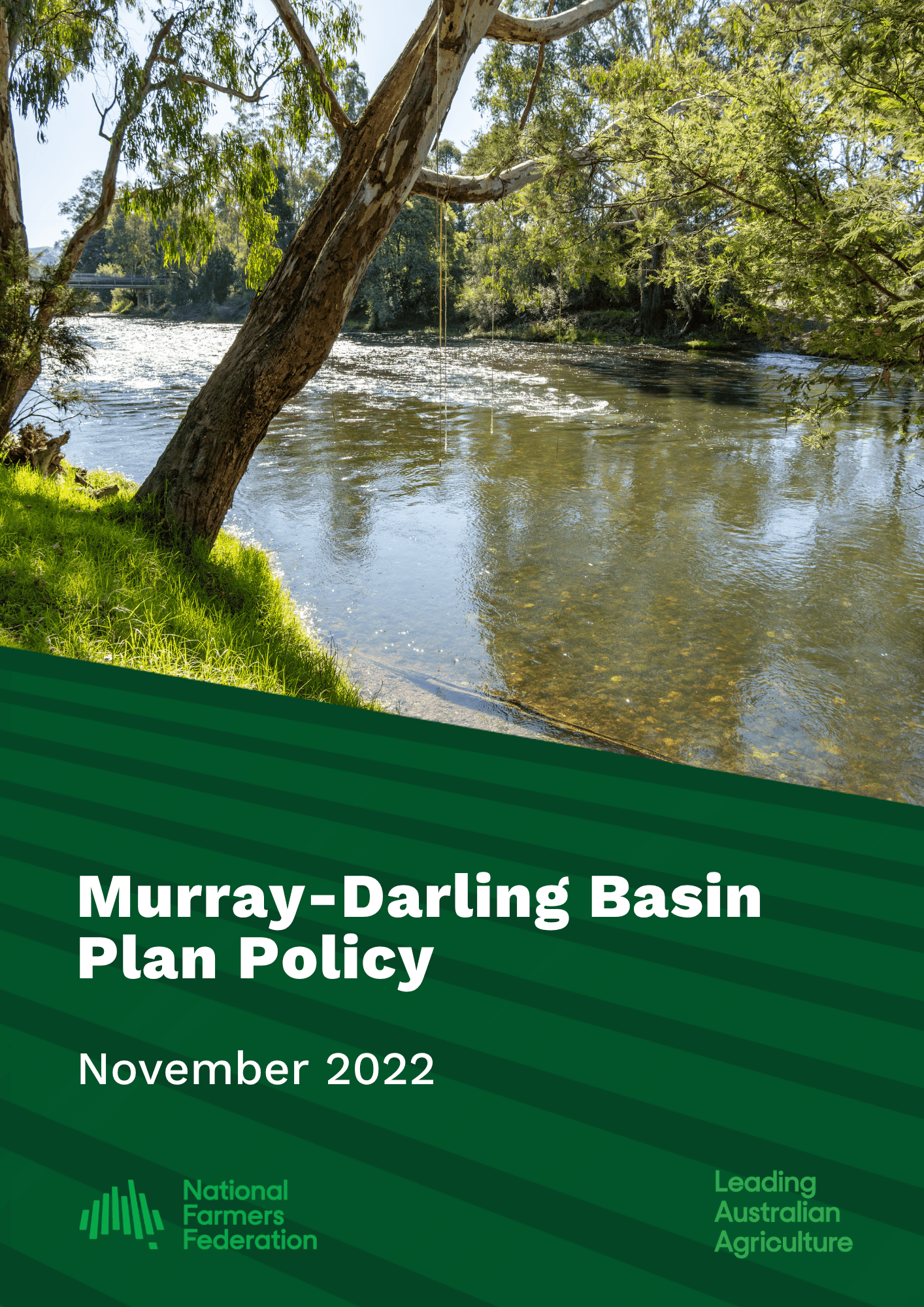
Murray-Darling Basin Plan

The NFF's major focus in the water policy area is ensuring the balanced development of the Murray-Darling Basin Plan.

Following the intense community outrage around the release of the Guide to the Murray-Darling Basin Plan in October 2010, the Murray-Darling Basin Authority released the much anticipated proposed Murray-Darling Basin Plan in October 2011.

As of mid-2012, the proposed Basin Plan is nearing completion, and the NFF continues to lobby the Authority and the Australian Parliament extensively to ensure it achieves a balance between the environmental, social and economic needs of the Basin.

To date, the NFF remains very concerned that the Authority has been unable to substantiate a link between the water volumes proposed in the Plan and the outcomes that the Plan must achieve.

At the present time, the Plan still puts the environment ahead of farmers and communities; which the NFF and the Basin communities believe is unacceptable. A report prepared by Independent Economics has found that the proposed Plan is likely to permanently reduce employment by 2,100 jobs and income by $200 million in the south-west Murrumbidgee area alone.

Farmers have been at the forefront of water reform for the past 20 years and remain committed to better outcomes for the Basin: in fact, farmers have delivered over 4,000GL to the environment since water reform began in 1994. The NFF continues to push for greater balance through the delivery of infrastructure, water efficiency measures and better management.

More information
For more, view the NFF's recent submissions regarding water reform and the Murray-Darling Basin Plan.

National Water Initiative

The NFF played a pivotal role in the lead up to COAG National Water Initiative Intergovernmental Agreement.

The National Water Initiative remains the blueprint for water reform in Australia, building on the earlier 1994 Water Reform agenda, previously under the COAG Competition Reforms. At the highest level, the Initiative seeks to increase the productivity and efficiency of Australia’s water use, return all systems to environmentally sustainable levels of extraction, provide greater certainty for investment and the environment, and to ensure that water management regimes are responsive and fair.

The key elements include water access entitlements (property rights), water planning, provision for environmental and other public health benefits, resolve overallocated and overused systems, remove barriers to water trade and broaden the water market, clarify risk assignment, improve water accounting, improve water use efficiency and innovation in both urban and rural water, address future adjustment issues, and recognise groundwater and surface water connectivity.

The NFF supported the development and continues to support the implementation of the Initiative. Successful implementation is essential to underpin secure water entitlements and enable the confidence to invest in the irrigated agricultural business.

More information
For more information, view the NFF's recent submissions regarding the National Water Initiative.

Climate Change

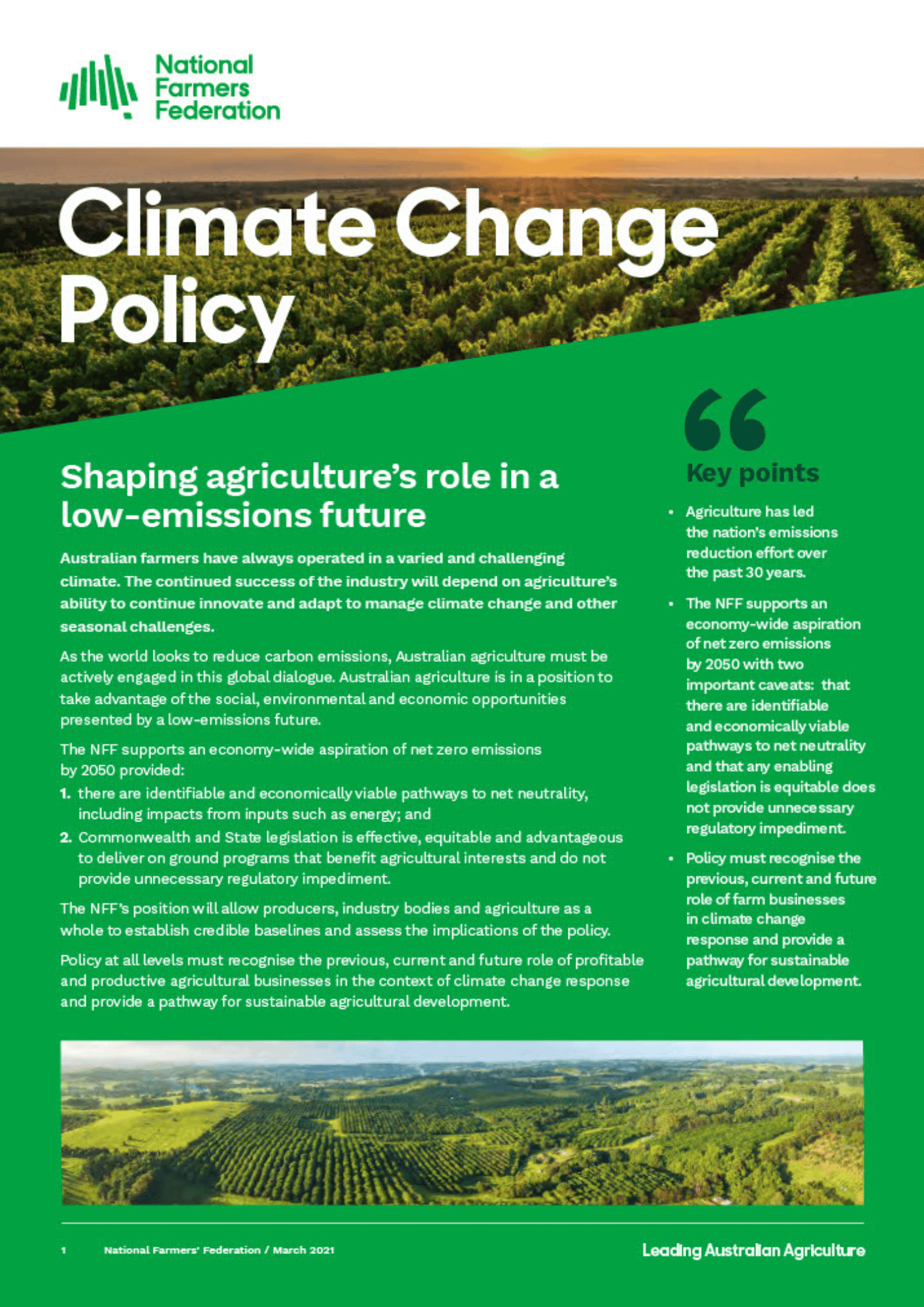
The changing climate is potentially the biggest issue facing Australian farmers in the future. As a sector so dependent on natural resources, climate change poses a significant challenge to agriculture.

As the ABARES report, 'Climate Change: Impacts on Australian Agriculture' shows, without actions to adapt to a changing climate and to mitigate the effects of greenhouse gases, Australian production of wheat, beef, dairy and sugar could decline by up to 10 percent by 2030 and 19 percent by 2050.

The implications of this for current farm enterprises and possible future industries vary, but show the need of all farmers to deal with hotter, drier and more variable conditions across much of Australia. To do so, farmers require access to the right tools to effectively manage the risks and capitalise on any opportunities arising from this change.

The NFF is active in both the areas of climate change mitigation and adaptation - mitigation through the Carbon Farming Initiative (for more, see below), and adaptation through a policy position that supports resilience.

Resilience essential means the ability for farmers to recover from shocks (such as drought) and return to pre-shock conditions and production levels. Resilience requires actions to help deal with changing conditions and reduce vulnerability - for farmers, this means actions around water, soil, trees, biodiversity, pastures, livestock, infrastructure, waste, energy, cropping and diversification.

We believe that Australian farmers must consider climate change (or climate variability) as a normal business 'risk', while maintaining a focus on productivity and profitability. A resilient farm is one that is profitable, sustainable and can effectively manage variations in the environment, its finances and the wider economic situation (like commodity prices, input costs and interest rates).

The NFF believes that provided with the correct tools - like research and development and robust drought policy - Australian farmers, and the agricultural sector, can continue to make an important contribution even in the face of a changing climate.

More information
For more on the carbon tax and the Carbon Farming Initiative see below, while for more information on drought policy reform and research and development, please visit the Farm Business and Productivity policy page.

For more on climate change and adaptation, view the NFF's recent submissions, or view an infographic on the road agriculture has travelled regarding climate change.

Carbon tax

After years of intense debate, the NFF expressed its disappointment at the passage of the carbon tax legislation through Parliament in November 2011.

The NFF had lobbied extensively on the carbon tax, and its predecessor, the Carbon Pollution Reduction Scheme, for the past four years.

While the NFF remains opposed to the carbon tax, we have been successful in securing agriculture’s exclusion, and our continued reinforcement of the costs the tax will have on Australian farmers resulted in the Government making additional concessions to agriculture: the removal of agricultural fuel from the scheme; the removal of heavy-vehicle fuel for a two year period; an announcement of $400 million to assist agriculture develop genuine carbon mitigation options through new research, development and extension; and the introduction of the voluntary, market-based Carbon Farming Initiative.

However despite these concessions, the NFF remains concerned about the impact the indirect costs of the carbon tax will have on the competitiveness of our sector. Three pieces of independent research by the Australian Farm Institute, the Government's own ABARES and IBISworld have found that the agricultural sector will wear the costs of the carbon tax. Farmers will be slugged with additional costs under the tax, due to higher electricity costs and the likely pass-through of costs from the processing sector.

Although as at 1 July 2012 the carbon tax is in effect, the NFF’s work is not done: we continue to lobby the Government to make permanent the exclusion of heavy vehicle fuel, and to provide the processing sector with the assistance it needs so as to not pass on the costs of the carbon tax to farmers.

More information
For more, view the NFF's recent submissions regarding the carbon tax.

Carbon Farming Initiative

The Carbon Farming Initiative (CFI), passed by the Australian Parliament as legislation in August 2011, enables farmers to be rewarded for carbon mitigation practices undertaken on-farm.

The NFF remains broadly supportive of the concept and intent of the CFI, as it recognises the positive role agriculture can play in mitigating against carbon emissions through on-farm management.

The NFF believes that voluntary, market-based mechanisms, using a carrot rather than a stick approach to carbon abatement, is the best way to engage with farmers in the carbon challenge. The CFI fits this description.

We also believe that the CFI will not transform farm income, particularly in the short- to medium-term. However, with a continued focus on productivity-based research, and the development of methodologies underpinning abatement projects, the NFF hopes that the CFI can make a meaningful contribution to Australia’s carbon mitigation effort.

The NFF had raised a number of key concerns regarding the draft legislation with Government, particularly surrounding the potential for shifting regional land use away from agriculture and towards forestation. These concerns were addressed prior to the passing of the legislation, however the NFF continues to closely monitor outcomes under the CFI to ensure that no unintended consequences emerge in regional Australia to the detriment of our farmers.

The priority now for the NFF is on education around the CFI. Farmers need to be aware of the responsibilities that come with the CFI and the NFF believes a detailed education program, utilising NFF members, the Landcare networks and other existing farmer extension networks, is vital.

More information
For more, view the NFF's recent submissions regarding the Carbon Farming Initiative.

Property Rights

Australian farmers have a proud record of environmental management. They recognise that the preservation of their natural resources is vital for their future livelihoods.

The desire for governments to regulate environmental outcomes must be viewed in this context. The property rights of farmers must be respected in relation to government decisions affecting land and water entitlements. Full and adequate compensation must be provided where property rights are compulsorily acquired by governments or where farmers are required to undertake management practices above and beyond their duty of care.

Unfortunately, the NFF believes there has been a substantial decline in support for the security of private property rights by courts and governments over the last 50 years. Too often we are seeing emergence of the modern problem of governments assuming the property right while leaving the title with the owner. This is unacceptable. The NFF believes that this balance must be urgently corrected, whether it be in relation to rights surrounding carbon credits, water, natural resource management or mining's interaction with farming resources.

More information
For more, view the NFF's recent submissions regarding property rights.

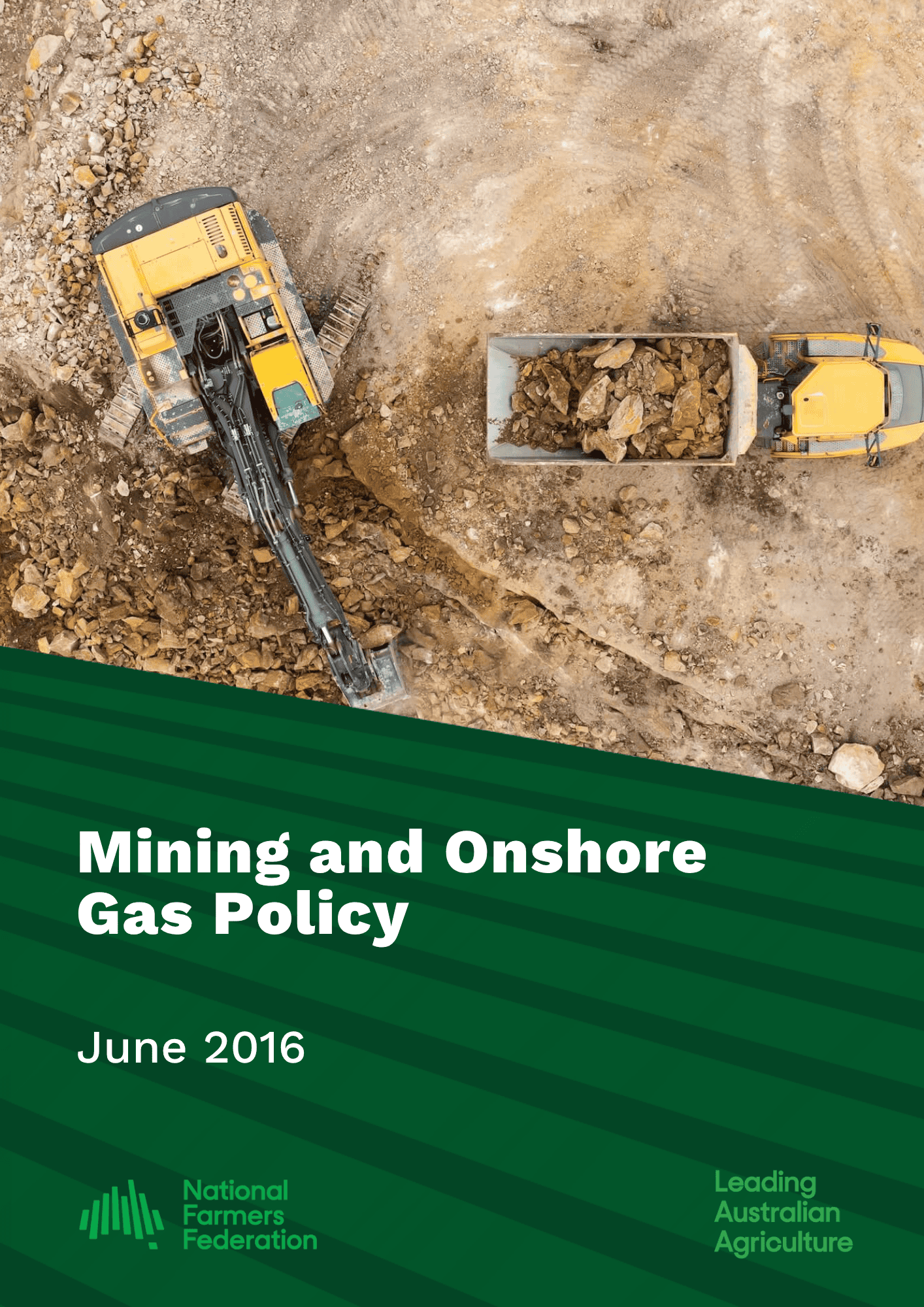
Mining and Coal Seam Gas

The rapid rise in mining and coal seam gas exploration and production has emerged as a major issue for farmers, who are concerned about the perverse affects such developments may have on agriculture, land and water resources.

The NFF established the Mining and Coal Seam Gas Taskforce in 2011 to tackle Federal issues around competing land use changes, the relationship between the agriculture, mining and coal seam gas industries, and to assist member organisations to work collaboratively on state based legislation.

The Taskforce's three main priorities are ensuring mining and coal seam gas developments pose no damage to productive agricultural land, no net negative impact on valuable water resources, and a demonstrated respect for farmers and regional communities.

More information
For more, view the NFF Mining and Petroleum Industries Policy (below) or view the NFF's recent submissions regarding mining and coal seam gas.

Environment Protection & Biodiversity Conservation Act

The Environment Protection and Biodiversity Conservation Act 1999 (the EPBC Act) is Australia's national environmental law. It is important for all Australian farmers to be aware of this law, as some agricultural activities may need Federal Government approval - in addition to state or local government approvals.

The EPBC Act protects matters that are of national environmental significance. Those most relevant to farmers are:

  • nationally threatened and migratory species
  • nationally threatened ecological communities
  • wetlands of international importance
  • world and national heritage properties, and
  • the Great Barrier Reef.

New farm activities, such as land clearing, may require approval from the Federal Environment Minister under national environment law.

In 2008, the EPBC Act underwent an independent review undertaken by Dr Allan Hawke (the Hawke Review), and in 2011, the Minister for Environment released the Government's response as part of a broad package of reforms for Australia’s national environment law. Under these reforms, the Government has committed to deliver better environmental protection focusing on whole regions and ecosystems, faster environmental assessments, a national approach to environmental impact assessments that removes duplication and cuts red tape and provide better upfront guidance on legislation requirements.

The Government has set itself two clear deadlines in relation to the EBPC Act reform process: completed environmental standards and bilateral arrangements by December 2012 and agreement from States and Territories by March 2013. The NFF is actively involved in the reform agenda.

To help farmers understand the EPBC Act and how it applies to their farm activities, the NFF has an Environment Liaison Officer, Jol Taber, on secondment from the Department of Sustainability, Environment, Water, Population and Communities.

If you are unsure about your farm activities and how they apply to the EPBC Act, it is best to check by calling the Liaison Officer on 1800 704 520. You should also check state and local governments’ approval requirements.

More information
More information on the EPBC Act, how it applies to farmers and how to seek a referral is available via the NFF's Liaison Officers page of this website. You will also find full contact details for the Environment Liaison Officer, Jol Taber, on this page.

For more on NFF's position re the EPBC Act, view our recent submissions.

Caring for our Country

Caring for our Country is the Australian Government's environmental management program, providing funding support for farmers and land managers to engage in natural resource management. Important initiatives such as Landcare, the Environmental Stewardship Program, regional NRM bodies and the National Reserve System are funded from the Caring for our Country program.

The NFF has been actively involved in this program: providing advice to the Government as part of the Caring for our Country Review in 2011, and lobbying for the continuation of the Environmental Stewardship Program in the lead up to the 2012 Federal Budget. The NFF has welcomed the Government's decision to continue the program for another five years, with a $2.2 billion commitment to Caring for our Country for 2013-2018. From 2013, Caring for our Country will be split into two streams: Sustainable Agriculture and Sustainable Environment. NFF is currently considering advice on the Sustainable Agriculture stream.

More information
For more, visit the Caring for our Country website or view the NFF's recent submission.

Landcare

The national Landcare program began in 1989 with a joint agreement between the National Farmers' Federation and the Australian Conservation Foundation. Then Prime Minister Bob Hawke announced government support for the national program, declaring the 1990s as the Decade of Landcare and pledging an unprecedented level of national funding for landcare and nature conservation.

Today, Landcare consists of 6,000 Landcare and Coastcare groups across the country, with some 100,000 volunteers dedicated to planting trees and shrubs, fencing off streams and gullies to protect regrowth and restoring wetlands.

Farmers are active participants in Landcare, making significant contributions to combating soil salinity and erosion through sound land management practices and sustainable productivity. According to a recent survey by Landcare, some 93 percent of farmers practice Landcare on their farms.

More information
For more, visit the Landcare website.

Wildlife corridors

The Government is currently developing the draft National Wildlife Corridors Plan, which will outline how the Government will establish and manage a national network of wildlife corridors across Australia.

The NFF is actively engaged in the development of this Plan, as we believe it is essential that it takes into account the important role that Australian farmers play as environmental stewards.

For farmers, three things are important in the development of the National Wildlife Corridors Plan: that the Plan does not result in more red tape or regulation around what happens on farms; that land title will not be changed as a result of a wildlife corridor declaration; and that farmers will not be forced into any conservation action under the proposed Plan, meaning that all actions undertaken by farmers are voluntary.

Under the proposed draft Plan, there will be an opportunity for farmers and private landholders to receive funding for ecosystem and biodiversity management; going some way to farmers being rewarded for the work they do in protecting Australia’s natural environment.

The NFF has raised concerns re the management of invasive animals, plants, fire and other risks within the wildlife corridors, calling for a greater focus on invasive species and fire under round one of the Biodiversity Fund. The NFF will continue to work with Government to ensure this commitment is made through the Plan.

More information
For more, view the NFF's recent submissions regarding wildlife corridors.

< Policy & Issues